STEALTH CONTROLS
Invisible to everyone. Visible to you.
Drag the divider to compare the clean shared-screen view with the ABH Assistant interface visible only on your screen.

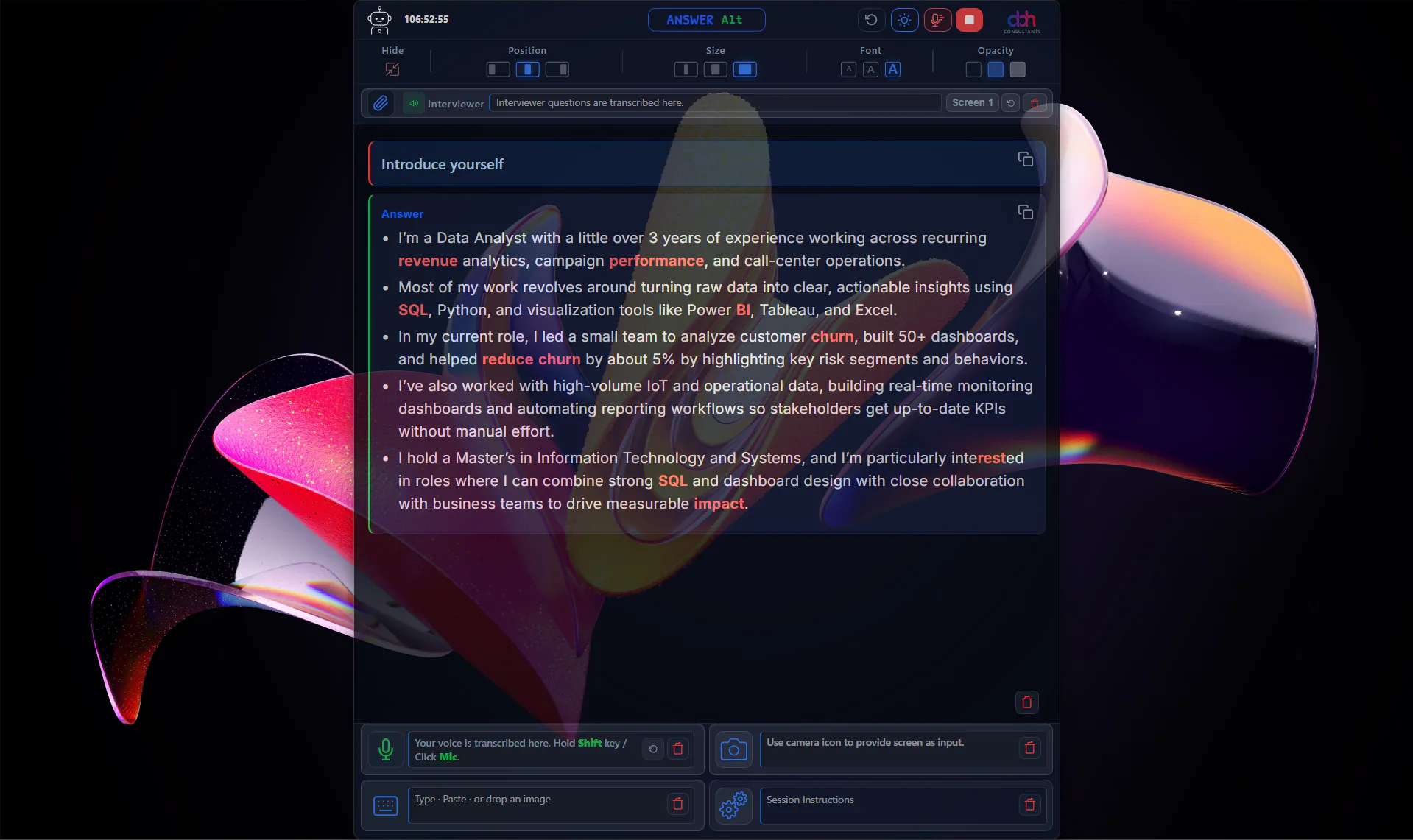
Size
Adjust the app size to fit your workspace.
Position
Place the app at left, center, right, or bottom.
Opacity
Control transparency for better subtlety and comfort.
Font
Increase or reduce font size for easier reading.
PRODUCT COMPARISON
Why choose ABH Assistant?
Many tools focus on either chat, meetings, or interview preparation.
ABH Assistant brings the important parts together:
| Feature | ABHAssistant | GenericChatbot | Meeting NoteTool | Interview PrepTool |
|---|---|---|---|---|
| Real-time answer generation | Yes | Limited | Limited | Yes |
| Resume-aware answers | Yes | Limited | No | Yes |
| Job description context | Yes | Limited | No | Yes |
| Screenshot capture | Yes | No | No | Limited |
| Coding support | Yes | Yes, but not workflow-based | No | Limited / varies |
| Voice input | Yes | Limited | Yes | Varies |
| File attachments | Yes | Yes | Limited | Varies |
| Session instructions | Yes | Manual prompting | No | Limited |
| Desktop workflow | Yes | No | Sometimes | Varies |
| PDF session export | Yes | Manual | Meeting summary only | Varies |
| Usage balance tracking | Yes | No | No | Varies |

Frequently asked questions
What is an AI interview assistant?
An AI interview assistant is software that helps candidates understand and respond to interview questions. Unlike a general chatbot, it is built around the pace and structure of interviews: it can take in a question through audio, text or a screenshot, consider the candidate's background and the target role, and return structured response guidance quickly. Some products focus on preparation and mock interviews, while others also support permitted live scenarios such as accessibility support or open-resource assessments.
What does ABH Assistant do?
ABH Assistant converts interview questions into structured, context-aware response guidance. You can supply a question through supported audio capture, typed text, selected text, screenshots, images or code, and add context such as your resume, the job description, skills and projects. The assistant identifies the type of question — behavioral, technical, coding or scenario-based — and prepares guidance in your choice of depth, from a short direct answer to a detailed walkthrough.
Is ABH Assistant a real-time AI interview assistant?
Yes. ABH Assistant is designed for the speed of live conversations. It can capture spoken questions from supported audio sources, and it accepts instant text, screenshot and code input, so guidance is available while a discussion is still in progress. Response depth is selectable: Flash mode favors speed for short questions, while Balanced and Deep Dive trade a little time for more explanation. Real-time performance still depends on factors like audio quality and network conditions.
Can I choose short or detailed answers?
Yes. ABH Assistant offers three response depths. Flash produces a direct, immediate answer for quick questions. Balanced adds enough explanation and context for most interview questions. Deep Dive produces a detailed response for complex technical, architectural, analytical or scenario-based questions. You can set a default for the session and still adjust per question, which helps you match the rhythm of the conversation.
How should I prepare ABH Assistant before an interview?
Three steps make the biggest difference. First, add context: your current resume, the job description for the role, key projects, and any session-specific instructions such as preferred answer style. Second, configure the session: choose the interview type and a default response depth. Third, test the setup — audio capture, screenshot capture and, if relevant, screen-sharing behavior — using the same platform and settings your interview will use. A ten-minute test run prevents most live surprises.
Can ABH Assistant handle follow-up questions?
Yes. ABH Assistant maintains conversational context within a session, so when an interviewer says "why did you choose that approach?" or "what would you change at ten times the scale?", the guidance builds on the current discussion instead of starting from scratch. This matters most in coding and system-design rounds, where interviews are structured as a chain of follow-ups on one problem.
Can I provide my resume?
Yes, and it is recommended. When you add your resume, ABH Assistant grounds its guidance in your actual employers, projects, skills and accomplishments, which makes suggested answers sound like you instead of a template. You can also add a professional summary, project history, technical skills, target role and seniority. The assistant is designed to keep separate employers and projects separate rather than blending them into fabricated examples.
Does ABH Assistant use the job description?
Yes. A job description you supply is used as role context: it tells the assistant which skills, technologies and responsibilities the interviewer is likely to care about, so guidance can emphasize the most relevant parts of your background. Importantly, the job description is not treated as your own experience. If the role requires something you have not done, the assistant is designed to help you demonstrate related knowledge or transferable skills instead of claiming prior hands-on work.
Can ABH Assistant analyze screenshots?
Yes. You can capture or upload screenshots containing coding problems, source code, SQL queries, error messages, architecture diagrams, data tables, charts, user interfaces, written case studies or multiple-choice questions. ABH Assistant interprets supported visual content and prepares guidance appropriate to what it sees — for example, a solution outline for a coding problem or an explanation of an error message. Clear, readable screenshots produce the best results.
Can ABH Assistant help non-native English speakers?
Yes, this is one of the most common use cases. Candidates who know their field well but interview in a second language often lose points to phrasing rather than knowledge. ABH Assistant provides clearly structured guidance that helps you organize what you already know into fluent, professional answers, and the depth options let you choose between concise phrasing and fuller explanations. It supports communication — the substance still needs to be yours.
Can ABH Assistant answer behavioral interview questions?
Yes. For prompts like "Tell me about a time when…" or "Describe a conflict…", ABH Assistant structures guidance around the situation, your task or responsibility, the actions you took, the reasoning behind them, the result, and what you learned. Because it draws on the resume and professional context you provide, the suggested structure points at your real experience rather than a generic script. You remain responsible for keeping examples truthful.
Can ABH Assistant help with technical interviews?
Yes. ABH Assistant structures technical answers in a layered way: a direct answer first, then a definition, why the concept matters, how it works, a practical example, advantages, limitations, alternatives and — when your context includes it — relevant experience. This structure works across areas such as software engineering, data engineering, data science, cloud computing, DevOps, databases, APIs, frontend and backend development, and system design.
Can ABH Assistant solve coding questions?
ABH Assistant can generate and explain code for coding questions, including problem restatement, clarifying assumptions, approach selection, working code, complexity analysis, edge cases, test cases, debugging help and alternative solutions. It supports common languages such as Python, Java, JavaScript, TypeScript, C#, C++ and SQL. You should always read, understand and validate generated code before relying on it — interviewers routinely probe follow-up details, and the responsibility for the solution stays with you.
Does ABH Assistant support coding interviews?
Yes. Coding interviews are a core workflow. Beyond generating code, ABH Assistant helps with the parts interviewers actually score: restating the problem, asking clarifying questions, choosing a data structure or algorithm, explaining the approach, analyzing time and space complexity, walking through edge cases and proposing tests. Questions can come in as text, code snippets or screenshots of an assessment page or editor.
Does ABH Assistant work for data-engineering interviews?
Yes. Data-engineering interviews mix SQL, pipeline design, data modeling, ETL and orchestration questions with cloud and system-design discussion. ABH Assistant handles SQL questions directly, structures answers about pipeline architecture and trade-offs, and uses your resume context to connect answers to the platforms and tools you have actually used. Screenshot input helps when a question arrives as a table schema or a query to debug.
Does ABH Assistant work for software-engineering interviews?
Yes. Software-engineering loops typically combine coding rounds, system-design discussions, debugging exercises and behavioral questions — and ABH Assistant covers each of those workflows. It supports the major general-purpose languages, structures system-design answers around requirements, components and trade-offs, and grounds behavioral guidance in your own project history when you provide it.
Does ABH Assistant support non-technical interviews?
Yes. The same context-aware approach applies to non-technical conversations: behavioral rounds, case interviews, leadership discussions, product and project-management interviews, sales conversations and customer-success scenarios. The assistant adapts the structure to the question type — a case question gets a framework-oriented response, while a leadership question gets guidance built around decisions, stakeholders and outcomes from your background.
Does ABH Assistant work with Zoom?
ABH Assistant is designed to run alongside Zoom as a separate application, capturing questions from supported audio and accepting text or screenshot input during the call. Because it does not plug into Zoom itself, there is no meeting-side integration to configure. As with any live setup, behavior can vary with your operating system, audio configuration and app versions, so test your exact setup before an important session.
Does ABH Assistant work with Google Meet?
Yes, ABH Assistant is designed to work alongside browser-based platforms like Google Meet. It runs independently of the browser, so it does not depend on Meet extensions or permissions inside the meeting. Audio capture depends on your system's audio routing, and screen-sharing behavior depends on whether you share a tab, a window or the entire screen — verifying your configuration in a test call is recommended.
Does ABH Assistant work with Microsoft Teams?
Yes, ABH Assistant is designed to operate alongside Microsoft Teams the same way it does with other meeting platforms: as an independent application that captures questions through supported audio, text and screenshots. Teams deployments vary more than most platforms — corporate policies, virtual desktops and managed devices can affect audio and screen-sharing behavior — so testing with your actual environment before the interview matters more here than anywhere else.
Is ABH Assistant visible during screen sharing?
ABH Assistant is designed to provide a private interface and to avoid appearing in supported screen-sharing and capture scenarios when its compatible desktop protections are active. That said, no tool can promise universal invisibility: behavior can vary by operating system, meeting platform, sharing method (tab, window or full screen), recording software, security software and application version. Always test the exact configuration you will use before an important session.
Is ABH Assistant better than a general-purpose chatbot?
They solve different problems. A general chatbot can answer interview questions if you type them in and repeatedly re-explain your background. ABH Assistant is purpose-built for interviews: session-level resume and job context, spoken-question capture, screenshot input, selectable response depth, and answer structures designed for how interviews are scored. For one-off practice a chatbot may be enough; for a complete interview workflow, a dedicated assistant removes the friction.
Can ABH Assistant guarantee that I will pass an interview?
No, and you should be skeptical of any tool that claims otherwise. Interview outcomes depend on your actual skills, your communication, the interviewer's judgment, competition for the role and factors nobody controls. What ABH Assistant can do is remove structural problems — rambling answers, missed question intent, forgotten relevant experience — so your real capabilities come through more clearly. Preparation and honest self-assessment still decide the outcome.
Is ABH Assistant the most powerful AI interview assistant?
We avoid that kind of claim because it is not verifiable. What we can state factually is what ABH Assistant is designed to provide: a complete interview-support workflow with multiple input methods (audio, text, screenshots, images, code), session-level resume and job-description context, three selectable response depths, coding-specific structure, and screen-sharing privacy protections for supported scenarios. Whether that combination is the best fit depends on your interview types and workflow — the comparison table above shows how it differs from a general chatbot.
Is using an AI interview assistant permitted?
It depends on the interview. Some employers explicitly allow open resources; some assessments prohibit outside tools; accessibility accommodations are a separate, often protected category; and mock interviews or preparation carry no restrictions at all. Review the instructions for your specific interview, and ask the employer when the rules are unclear. ABH Assistant is intended for preparation, practice, accessibility and communication support, and permitted real-time scenarios — not for circumventing rules.